
'Pursuant to the decision of the ICJ, Commander Kulbushan Jadhav has been informed of his rights under Article 36, Paragraph 1(b) of the Vienna Convention on Consular Relations'

Abdulqawi Ahmed Yusuf of the International Court of Justice is appointed as the 3rd arbitrator in Voda tax row.

Election for final seat on the International Court of Justice stays deadlocked.

Following is the timeline of the Kulbhushan Jadhav case.

The statement claimed that the Hague-based ICJ in its judgment did not accept India's plea to 'acquit/release' Jadhav.

The External Affairs Ministry said the 'landmark judgment' validated India's position on the matter 'fully' and asked Pakistan to implement the directive of the ICJ immediately.

People in Jadhav's native Javli village in Satara district condemned Pakistan and demanded immediate release of the retired Indian Navy officer sentenced to death by a Pakistan army court on alleged 'espionage' charges.

India approached the ICJ in May 2017 against Pakistan for denying consular access to Jadhav.

There were cheers of joy and sighs of relief as Judge Abdulqawi Ahmed Yusuf, ICJ president, read out the court's decision.

India based its case on two broad issues -- breach of Vienna Convention on consular access and the process of resolution.

The World Court had, on Wednesday, ordered Pakistan not to execute Kulbhushan Jadhav and had directed "effective review and reconsideration" of his conviction and death sentence by a military court.

Salve said it is important to be 'positive' after such a positive ruling.
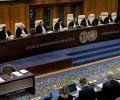
The bench also ruled that Pakistan had violated India's rights to consular visits after his arrest.
Rubbishing Pakistan's claim of a victory in the case, External Affairs Ministry Spokesperson Raveesh Kumar said Islamabad has its 'own compulsions to lie' to its people.

India questioned the functioning of Pakistan's notorious military courts.
 © 2026 Rediff.com - Advertise with us - Disclaimer - Privacy Policy - Sitemap - Feedback - About us - Terms of use - Grievances